RENO, Nev.— This summer's Lake Tahoe Shakespeare Festival has produced an unlikely star: a deaf pit bull named Michael who narrowly escaped euthanasia.
The 6-year-old American Staffordshire terrier has turned out to be a hoot in his role as Crab the dog in the Bard's comedy, "The Two Gentlemen of Verona," festival organizers and audience members said.
Michael plays a miscreant of sorts who doesn't care to please his owner, they said, and his varied spontaneous reactions to his owner's laments on stage frequently prompt laughter. Among other things, Michael has scratched his head, chewed on a foot or thrown apathetic glances at the audience when Crab's owner, Launce, played by Kevin Crouch, pours his heart out.
Joan O'Lear, of Tahoe Vista, Calif., remembers the night she watched as Michael spotted a tiny service dog in the front row. "He honed in on her and whined at the perfectly timed monologue that the actor was giving about how even the dog didn't care about his plight," she recalled. "It was so funny. The Shakespeare play was good, but Mike added the crowning touch."
Michael's real owner, Michelle Okashima, of Incline Village, told the North Lake Tahoe Bonanza there's "a great chemistry between Mike and Kevin that makes their stage time together electric and believable."
Not bad for a dog who was scheduled for euthanasia in July 2006 in Reno after he was found running loose and no one claimed him.
Okashima said she's grateful for his last-minute rescue by Nanette Cronk of the Humane Society of Truckee-Tahoe and his selection for the play. Michael and another dog were chosen to play Crab out of 11 dogs that auditioned. Michael appears in two or three plays a week, performing in three scenes for a total of about 15 minutes each night.
"What are the odds they would pick a pit bull?" Okashima told The Associated Press. "All the time they face rejection in our society. I was shocked he got the part. I really appreciate the fact they gave him a shot."
Michael has posed no problem other than the time he jumped offstage in dress rehearsal because a woman smuggled a Shih Tzu in her purse inside the theater, she added.
Michael also is a registered therapy dog who visits hospitals, schools and veteran's homes. He also has been used to raise money for cancer research.
"He got a second chance, and I believe in giving back," said Okashima, an employee at Scraps Dog Bakery in Kings Beach, Calif.
Unlike his role in the play, Michael aims to please people in real life. "He's a wonderful guy, real sweet. I call him my big lump of brown sugar," she said.
Wednesday, October 3, 2012

Saturday, June 30, 2012
A Vet's List Of Top Poisons The Affect City Dogs

Top Poisons Plaguing City Dogs
By Sarah Hughes, DVM
Toxic ingestions account for a significant portion of the cases seen in animal emergency rooms. Our canine companions are regularly exposed to the foods we eat, the drugs we take, and the chemicals we bring into our homes, garages, and yards. Following are some of the most common toxicities we see in the urban (vs. rural) veterinary emergency department:
Rat poison
Rat bait ingestions cause life-threatening changes in our pets. If caught within a few hours, treatment can be relatively straightforward and may have a good outcome. If not caught immediately, rat bait ingestion can be critical, and the outcome is far more grave. If you notice or suspect rat poison ingestion, immediately take your pet to the closest emergency room. Bring along the substance and its packaging. There are several types of rat poison that work in different ways, and each type is treated differently.
Antidepressant medications, amphetamines, and other medications
Ingestion of these substances can cause “Serotonin Syndrome,” in which serotonin receptors are overstimulated. Signs include mental abnormalities, vomiting, difficulty breathing, drooling, seizures, arrhythmias, and tremors. Usually these reactions begin within minutes and can progress to death within a few hours. Seek immediate veterinary care, as early treatment improves the prognosis.
Grapes/raisins, onions, and xylitol
Raisin/grape toxicity can cause acute kidney failure in dogs. Vomiting is the most common initial sign. Onions (along with leeks, shallots, and garlic) can damage our pets’ red blood cells. Xylitol, a commonly used sweetener in gum, toothpaste, etc., causes low blood sugar, liver failure, and abnormal coagulation.
Non-steroidal anti-inflammatories (NSAIDs)
Ingestion of these common over-the-counter medications can threaten many interior organs, including the liver, kidneys, and intestines. NSAIDs produced for both human and animal use can be toxic. If you believe your pet has ingested such medication, try to establish how much and at what time, and take along the pill container with you and your pet to the veterinary hospital.
Chocolate and coffee
While humans can savor a chocolate dessert or a morning coffee without worry, our companion animals cannot. In addition to chocolate, caffeine stimulants, energy boosters, and cocoa bean mulch contain theobromine and caffeine, which adversely affect the central nervous system, gastrointestinal tract, heart, and kidneys in dogs. The darker the chocolate, the greater potential for serious problems, including death.
Marijuana
Signs of marijuana ingestion in dogs include lethargy and incoordination, as it affects the brain. It is possible for pets to consume toxic doses, so do not delay treatment.
Antifreeze
Though it is colorless, odorless, and sweet-tasting, ethylene glycol (antifreeze) is a serious toxin. Even in small doses, it can cause severe kidney damage. According to the American Association of Poison Control Centers, ethylene glycol ingestion in animals is the second most common cause of fatal poisoning, but prognosis for recovery can be good if treated soon. This is a serious medical emergency!
Tremorgenic mycotoxins (found in spoiled food) or metaldehyde (slug bait)
Sometimes people do not think of mycotoxins in an urban setting, but a dog with dietary indiscretion and access to the compost pile may be at risk. Clinical signs are mostly anxiety, restlessness, and tremors and can progress to more serious neurologic signs. Slug bait can be toxic to animals though skin contact, inhalation, and ingestion. Early and aggressive treatment is needed for a favorable recovery.
Warning: You may have heard about using hydrogen peroxide to induce vomiting at home as a way to deal with poisons, but this is not always recommended. Your pet should first see a veterinarian to assess if it is safe for the pet to vomit up the toxicant and to determine if vomiting is appropriate for a particular toxin (sometimes it causes even more damage)
In the event that you notice your pet eating something he/she shouldn’t, or if you aren’t sure, do not hesitate to call your regular veterinarian or the closest emergency clinic. Be prepared to discuss what, when, and how much your dog ate. Any information you can provide (including labels/packaging) will be helpful.
Depending on the situation, your veterinarian may recommend that you bring your pet in immediately, carefully monitor your pet at home, or call the National Animal Poison Control Center. The NAPCC is a call center staffed with veterinarians who have additional training in toxicology. They are available 24/7 to answer calls about any potential toxin ingestion by pets. The phone number is 888-426-4435. Please post it in a prominent place. You never know when it may be a life-saving phone call.
Sarah Hughes, DVM, is part of the 2011- 2012 intern class at VCA San Francisco Veterinary Specialists. She received a B.S. in animal science and her DVM from the University of Illinois at Champaign-Urbana. This article is based on a continuing education lecture presented by Heidi Houchen, DVM, VCA Northwest Veterinary Specialists, in February 2012. It appeared in the June 2012 issue of Bay Woof featuring Oscar the Dachshund, shown above.
Saturday, April 7, 2012
Sweet Small Dogs Waiting For Their Forever Families
Good dogs can come in little packages! All of these five small sweethearts are waiting patiently for their forever families at Oakland Animal Services where I volunteer. I have gotten to know these little guys, and each one has a distinctively charming personality. If you live in Northern California, or you know someone who does, send them over to OAS to get acquainted with Mr. Big, Crystal, Rocky, Scooter, or Trixie!
 I'm Mr. Big and as you can see, I'm a very handsome little Chihuahua. I came to the shelter in early March as a stray. I'm about three years old and I'm very good-natured and have gotten along well with other dogs that I've met here at the shelter. I'm already learning to sit for treats. I walk nicely on a leash and would be a good walking companion with you around your neighborhood. I really enjoy sitting in laps and just relaxing, like watching TV or enjoying the sun. Write down my ID (#04838) and come meet me at Oakland Animal Services!
 Hi, my name is Crystal and I am a beautiful girl who can not keep my kisses to myself! In fact, I can't think of any better place to be but on your lap. I can sit and walk pretty well on leash. I have experience living with a family so I am sure I will blend with yours very well, if there are no children. What can I say, I would love to be your center of attention. I am already fixed so I can go home with you as soon as the adoption is approved. Isn't that great? Please come and meet me soon. I will have a kiss waiting for you! Crystal's ID is #06043 at Oakland Animal Services.
 I'm Rocky - a very handsome, happy and friendly little guy. I came to the shelter as a stray on 2/6/12. I'm about 2 years old and I already know to sit for treats. I also love to play fetch! You can see from my picture that I'm very eager to learn more from you. I will be a great companion on your walks, playing in the park, watching TV, cuddling, or whatever you want to do! Come to meet me soon at Oakland Animal Services. Rocky's ID is #06044.
 Hi, my name is Scooter. I am a great guy who loves to sunbathe and be around good friends. I am about 3-years-old and was found as a stray, so I have a few tricks up my sleeve. I am looking for my forever home where I can enjoy walks, being petted and playing. I am a fun-loving dog who you must come in and meet! I am already fixed and I am ready to go home! Scooter's ID is #04826.
 Hi there! My name is Trixie, and I'm a small, 1.5 year old chihuahua mix with a beautiful, distinctive striped tail. I get compliments on it all the time! I came in to the shelter as a stray at the end of February, and despite all that I've been through, I'm still a gentle, affectionate lady. I walk very, very nicely on my leash and when we're done taking a stroll, I'd love to cuddle up on a warm lap. The shelter environment is a little stressful for me, so I'm looking for a nice, calm home without children under 12 years old to settle down into. Will you come be my lifelong best friend? Write down my ID (#08766) and come ask for me at Oakland Animal Services!
 I'm Mr. Big and as you can see, I'm a very handsome little Chihuahua. I came to the shelter in early March as a stray. I'm about three years old and I'm very good-natured and have gotten along well with other dogs that I've met here at the shelter. I'm already learning to sit for treats. I walk nicely on a leash and would be a good walking companion with you around your neighborhood. I really enjoy sitting in laps and just relaxing, like watching TV or enjoying the sun. Write down my ID (#04838) and come meet me at Oakland Animal Services!
 Hi, my name is Crystal and I am a beautiful girl who can not keep my kisses to myself! In fact, I can't think of any better place to be but on your lap. I can sit and walk pretty well on leash. I have experience living with a family so I am sure I will blend with yours very well, if there are no children. What can I say, I would love to be your center of attention. I am already fixed so I can go home with you as soon as the adoption is approved. Isn't that great? Please come and meet me soon. I will have a kiss waiting for you! Crystal's ID is #06043 at Oakland Animal Services.
 I'm Rocky - a very handsome, happy and friendly little guy. I came to the shelter as a stray on 2/6/12. I'm about 2 years old and I already know to sit for treats. I also love to play fetch! You can see from my picture that I'm very eager to learn more from you. I will be a great companion on your walks, playing in the park, watching TV, cuddling, or whatever you want to do! Come to meet me soon at Oakland Animal Services. Rocky's ID is #06044.
 Hi, my name is Scooter. I am a great guy who loves to sunbathe and be around good friends. I am about 3-years-old and was found as a stray, so I have a few tricks up my sleeve. I am looking for my forever home where I can enjoy walks, being petted and playing. I am a fun-loving dog who you must come in and meet! I am already fixed and I am ready to go home! Scooter's ID is #04826.
 Hi there! My name is Trixie, and I'm a small, 1.5 year old chihuahua mix with a beautiful, distinctive striped tail. I get compliments on it all the time! I came in to the shelter as a stray at the end of February, and despite all that I've been through, I'm still a gentle, affectionate lady. I walk very, very nicely on my leash and when we're done taking a stroll, I'd love to cuddle up on a warm lap. The shelter environment is a little stressful for me, so I'm looking for a nice, calm home without children under 12 years old to settle down into. Will you come be my lifelong best friend? Write down my ID (#08766) and come ask for me at Oakland Animal Services!
Sunday, April 1, 2012
Hand-knit Sweaters Help Shelter Pups Stand Out
 Reading about this wonderful initiative on the Oakland Animal Services website made my day. What a fantastic idea! Check it out...
Aki James, an Oakland Police Department employee, received her call to action after reading a story about animals rescued by Oakland Animal Services (OAS). As fate would have it, she ran into OAS Director Megan Webb just after having read the story, and, in talking about the animals at the shelter, Megan told her about our small-dog population and how so many of the Chihuahua mixes look similar. Aki offered to knit sweaters for the rescued animals waiting in the shelter for their chance at a new home.
“Individual sweaters could really help the dogs stand out to potential adopters,” Megan told Aki. And Aki was sold.
After speaking with Megan, Aki decided to take it upon herself (and her knitting group, City Stitchers, a knitting group made up of city of Oakland employees) to knit thirty sweaters for the small breed dogs at OAS. A fellow knitter from City Stitchers, and Aki delivered thirty doggie sweaters to Oakland Animal Service on Valentine’s Day. As OAS staff and volunteers brought out several small dogs to try on the sweaters, an impromptu fashion show was under way.
Aki told us that as she knits doggie sweaters, she thinks of the day when every adoptable dog will have a home. It is her dream for animal cruelty and over-breeding to come to an end.
“I dream, stitch by stitch, that my sweater will get each precious little dog adopted,” Aki said. “I am like Kevin Costner in Field of Dreams. I didn’t hear the magical voice though, but this is my Needle of Dreams. If we knit, they will come . . . to adopt dogs, that is.”
Saturday, March 24, 2012
The Secret Snuggle Society


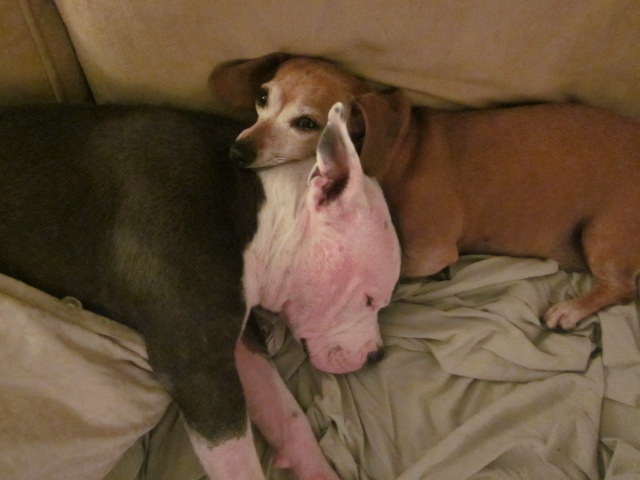 There's no doubt about it: Dewey and Tulip are an odd couple. Our little three-legged guy has at least ten years on his rambunctious adolescent sister. While Dewey is content to sleep the day away (with the exception of his all-important meal breaks of course), Tulip has an insatiable appetite for fun and adventure. She adores swimming and playing fetch, and it takes a LOT to wear her out. So, where do these two opposites find common ground? It appears that the answer is snuggling. I will come across them cuddled up together, but once the camera comes out, the spell is usually broken. Here is documentation of their secret snuggle society...
Tuesday, March 20, 2012
Homeless Rabbits Need Your Help!
 There are dozens of homeless rabbits in Oakland, and they need your help! Oakland Animal Services, the shelter where I volunteer, has been inundated with abandoned bunnies like Thelma and Louise pictured here. The San Francisco Chronicle recently ran an article with more info...
Oakland Animal Services takes in any animal that comes through its doors, but staff members are short-handed after a sudden wave of rabbits filled the shelter with long ears and twitching noses.
The city-run shelter has received more than a dozen bunnies in the last two weeks, including 10 from one family, said Amy Jones, the shelter’s volunteer program manager.
The Oakland family had started to breed the bunnies but the situation “got out of control,” Jones said.
“People don’t realize that rabbits have a gestation period of only 30 days,” she said. Rabbits are also ready to breed at six months and can have a dozen babies per litter.
The most recent arrivals pushed the shelter’s total up to around 50 rabbits, which is “far, far more” than the shelter is equipped to handle, Jones said.
Local groups like Save a Bunny and House Rabbit Society took some of the rabbits off the shelter’s hands, but the shelter still has 31, one more than its maximum capacity, Jones said. The shelter prefers to keep its rabbit numbers around 15 or 20.
About six rabbits have been adopted in the past couple weeks, but an upcoming holiday will only add to the shelter’s problems.
“We need to get our numbers down before Easter comes around,” Jones said. “People think it’s cute to buy a baby rabbit for their kids for Easter, but they don’t realize rabbits are sensitive and are prey animals. Kids can often scare them.”
The shelter usually gets another wave of rabbit drop-offs a few weeks after Easter.
People interested in adopting a rabbit for an indoor pet can visit the shelter and pay a $35 adoption fee, Jones said. All the shelter’s rabbits are spayed and neutered before adoption.
Friday, March 16, 2012
Open Your Heart To A Muttville Senior Dog
Axl
 Coco
Coco
Bumper
 Mintey
 Annie
Annie Blackie
If you're like me, you are searching the sweet, soulful faces shown above and wondering about the many stories they suggest. Homeless senior dogs have often been through so much - rejection in favor of a younger pet or new baby, abandonment due to medical reasons, displacement because of an owner's disability or death - and yet they ask for so little.
When we adopted three-legged Dewey in 2008, he was thought to be at least ten years old. The only background information we had about him was that he had been picked up as a stray in Spokane, Washington. It was a mystery how he had come to have an amputated hind leg, and we knew nothing about the first decade of his life. None of this stopped Dewey from settling right into our family as if he had always belonged.
In my experience, senior shelter dogs just want want a peaceful "retirement" in a loving home where they can relax and be adored.These six old souls, Axl, Coco, Bumper, Mintey, Annie, and Blackie, are patiently waiting for families who will give them a second chance. They are available for adoption through Muttville Senior dog Rescue, based in San Francisco: www.muttville.org
Tuesday, March 13, 2012
Why Mixed Breeds Make Great Companion Animals
 While I adore dogs of all types, I definitely have a soft spot in my heart for mutts. Not only are mixed breed pooches amazingly diverse in appearance (ever seen a Corgi/Husky mix?!?), many studies have shown that they tend to be healthier and longer-lived on average when compared with their purebred counterparts. The Peninsula Humane Society & SPCA states the case for mutts on their website:
Why Mixed Breeds Make Great Companion Animals
Each breed is descended from a limited number of dogs. Because breeders have sought to create animals who have certain fixed attributes, purebred dogs today are very inbred. Genetically this means that, while all purebreds do not have significant health problems, they are predisposed to a range of hereditary and congenital diseases, including skin and eye conditions, allergies, various cancers, cardiac problems, and abnormalities in the kidneys and other organs.
A 1994 Time magazine article on the effects of overbreeding reported that as many as 25 percent of the 20 million purebred dogs in the US are afflicted with a serious genetic problem.
Mixed breeds, on the other hand, have something called hybrid vigor. When you mix two or more separate gene pools, the recessive genes that carry the health problems are buried. As a result, you get a healthier animal. Simply put, mixed-breed dogs are, in general, healthier than their purebred cousins and typically require fewer visits to the veterinarian.
Mixed breeds are also more temperamentally sound than purebreds. Not all chows are aggressive, not all cockers have a nervous tendency to bite and not all retrievers are gentle, but generalizations about breed temperament often hold true, at least to some extent. Mixed breeds are typically less extreme temperamentally. Character and behavioral traits do manifest in mixed-breed dogs, but in a diluted form.
There is a final, compelling reason to adopt a mutt rather than a purebred. Our shelters are filled with primarily mixed-breed dogs in need of good homes. With the tragedy of pet overpopulation still far from being solved, I can't see perpetuating a market for yet more dogs.
In the Time magazine article cited above, syndicated animal columnist Mike Capuzzo noted, "Mutts are the Hondas of the dog world. They're cheap, reliable and what nature intended in the first place.
Subscribe to:
Posts (Atom)


 Posts
Posts

